Originally posted by The Gray Man at American Partisan.
In a conflict environment, the guerrilla may still have to continue living and operating within society and conduct himself as a regular civilian at times. This is simply part of being a guerrilla, it's part of what differentiates a guerrilla from your basic battlefield combatant. It's the ability to not just "blend in", but to be a part of that society and environment.
With that said, the guerilla always needs to be thinking ahead, even when, especially when, he is functioning "normally" in his day-to-day civilian living routine. Part of that is always being keen to picking up intelligence and information useful to the guerrilla's cause. People you meet will sometimes have that information, and you'll need to know how to spot those people and further, how to assess whether or not they are useful as a source.
Prior to putting any time into source finding, you're going to need to figure out what you need to know. You need to find out what your "intelligence gaps" are. Go over the information you have about a particular area, decide what questions you'd like to answer and develop some "priority intelligence requirements" (PIRs). Once you have your PIRs, you can start finding ways to collect against those PIRs. The guerrilla is going to need to get good at collecting from human sources.
There is an assessment tool that goes by an acronym that will assist in figuring out the usefulness of potential human source. The word is "PAMSSA", or also "PA-MSSA". I'll go into some detail, as it can be useful to the guerrilla, since it can be a bit different for a soldier in a uniformed military.
The "P" stands for placement. If a potential source has placement, then it means they have a spacial or geographical position to the information you seek. A source can not help you gather information if they never have placement anywhere near the information. To use a simple example, suppose you would like to start gathering medical information about the patients in a local hospital. I don't really know why one would be interested in doing this, but it's a very simple fictional example for my purposes. Would your local garbage collector have placement in this case? The answer is not really. Even collecting the garbage from the hospital, from the loading docks, maybe he even occasionally has to enter the building, but he doesn't really have good placement. What about the housekeepers inside the hospital? Do they have placement? The answer is yes. They are in and out of the rooms and working among the patients on a regular basis. How about the nurses? Yes, of course. They have placement, possibly the best placement of the three.
The next step is "A" for access. Access means direct access to the information you seek. Go back to our hospital example. Now you'll see that the housekeepers who have decent placement do NOT have any sort of access, beyond perhaps remembering the faces of the patients they see. The nurses will have excellent access in this case. Are you starting to see what placement and access mean to finding a potential source of information? This is why the PA is often hyphenated and separated from the MSSA. You can't move forward on the PA-MSSA assessment tool if the person your assessing doesn't have adequate placement and access.
Moving on, we now must look at the potential source's motivation. This usually requires actually meeting and discussing with the source. You'll need to get an idea of what would motivate a source to willingly pass information to you. In Afghanistan, money was a big motivator for human sources, but that is often a major problem. Sources will always be willing to sell you information, and sometimes they're even willing to sell you false information. Other motivating factors that you'd rather see are a belief in whatever your cause is. If a source shares your beliefs and is interested in advancing your cause, that's a positive motivation. Maybe your source has been wronged by your enemy, or they're disgruntled about something and are driven to correct it. This isn't to say that money is always negative, since often a source considers a payment a sort of compensation for the risk they take when speaking with you. However, money as the sole motivating factor can often cause problems down the line. More on that below.
Next assessment step is suitability. When you're getting to know your potential source, you need to see if this person is even suitable to serve in this role. You need to look for some level of intelligence. If the person you're assessing isn't the sharpest tool in the shed, are they suitable? Do they even know anything about the information they're giving you? Are they impulsive? During their daily activities, are they going to do something stupid and get themselves in trouble, or even killed? Are they smart enough to do what I'm trying to get them to do, or to tell me? Or are they going to maintain good placement and access? Do they speak your language? Do they have any physical issues that hinder their ability to assist you? Are they emotionally stable? Mentally stable? You'll have to consider these things.
The next factor is susceptibility. This is consideration for how easily they will agree to work with you, or how easily they will agree to turn against you. A source with great placement and access is of no use if they're not willing to work with you and pass along the information you need, and even more dangerous is a source that will pass along information about you to your enemies. This topic can be greatly discussed once you get into the realm of witting and unwitting sources and the subject of elicitation. I mentioned above that I would say more on motivation. You'll have to keep in mind that having a good understanding of a source's motivation can help you overcome problems with susceptibility.
The final variable is accessibility. This questions the ease of access you have to the source. A source that you're unable to communicate with is useless. You'll need to assess how you will communicate with that source, how often, for how long, etc. This touches a bit on suitability as well. Does the source have the time and opportunity to contact you? Do they have multiple ways to communicate to you? Are they capable of using more complex means, like dead drops without screwing up? Are they too busy to meet with you regularly? One very important factor to look at is time sensitive information. Does your source have the ability to recognize important and/or time sensitive information (if not, they may not be suitable) and do they have the ability to get that information to you quickly and securely?
This source assessment tool is easily practiced in daily life. All you need to do is identify your intelligence requirement and start with placement and access, and work your way down the list. Be sure to reassess sources periodically. Develop communication plans with your contacts. Assess current sources for additional collection capabilities.
Tuesday, August 13, 2019

Wednesday, July 31, 2019
What's in your IFAK?
Whether you envision yourself to be an armed partisan, a minuteman, future freedom fighter or simply a prepared citizen, if you've got a fighting loadout, or anything of the sort, it needs to include an individual first-aid kit, or "IFAK". Your IFAK needs to be small enough to fit easily with your kit, preferably somewhere on or inside your load bearing equipment. I'll show you my own IFAK, and I encourage you to do some research and build one that fits your needs and your skillset.
When putting your kit together, please keep in mind the ABCs of airway, breathing and circulation. In the case of the IFAK, the airway and breathing tools are going to limited in most cases to little more than a naso-pharyngeal airway (NPA) inserted into the nose (specifically, one of your battle buddies inserting it into YOUR nose) and into the back of the throat. The circulation aspect is going to be covered by things like tourniquets and gauze bandages, as in, keeping the blood from circulating it's way out of your body.
Every IFAK is not going to be the same, but every IFAK does need to have a few of the same things at a minimum. Every kit needs to have some form of gauze bandages, another separate bandage capable of serving as a pressure dressing, and a robust tourniquet, preferably one that is commonly issued to military or police units, since they're designed to be quick and easy for someone to use under stress.
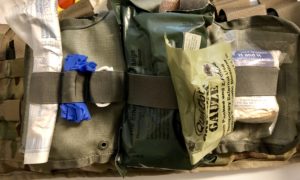
Below you'll see a picture of one of my own very simple IFAK kits opened up, this one assembled mostly from items I was issued when I was active duty, and from near "expired" items that were being thrown away by my former Army Reserve unit and the emergency room I currently work in. The pouch itself is an IFAK pouch and insert with NSN 8465-01-531-3647 and NSN 8465-01-531-3147 respectively. This pouch is MOLLE compatible and cheap to find online.
Inside I have a pack of regular gauze, a roll of medical tape, a pair of large nitrile gloves, a 28Fr NPA, a roll of "Coban" compression cling, a compression bandage for trauma dressings, some quick clotting gauze, and a "CAT” style tourniquet.
The medical tape is 3M brand "Durapore". In the ER we call this one the "fabric" tape, because it's made of a strong adhesive on some sort of silky fabric. It sticks very well and holds together, and if you write on it, it doesn’t wipe off or smear. Coban compression cling is excellent for pressure dressings on limbs. The packs of gauze wadded up under a Coban compression wrap is a great way of applying direct pressure.
I hope this helps you in your task of making an IFAK. If you don't have one, you need it. This kit cost me nothing, but the parts of it are cheap and easily found. Coban, gauze, tape, etc. is easily found in your local pharmacy and the NPA can be found online for less than $6 by searching "naso-pharyngeal airway for sale" on any non-Google engine. The tourniquet can be searched as well, and there are many under-$20 options available. A couple of websites I saw popping up in my searches while writing this were IsraeliFirstAid.com and EmergencySafetySupply.com. I haven't purchased anything at either site, but it looks like they've got what you need to build a nice little IFAK for yourself.
When putting your kit together, please keep in mind the ABCs of airway, breathing and circulation. In the case of the IFAK, the airway and breathing tools are going to limited in most cases to little more than a naso-pharyngeal airway (NPA) inserted into the nose (specifically, one of your battle buddies inserting it into YOUR nose) and into the back of the throat. The circulation aspect is going to be covered by things like tourniquets and gauze bandages, as in, keeping the blood from circulating it's way out of your body.
Every IFAK is not going to be the same, but every IFAK does need to have a few of the same things at a minimum. Every kit needs to have some form of gauze bandages, another separate bandage capable of serving as a pressure dressing, and a robust tourniquet, preferably one that is commonly issued to military or police units, since they're designed to be quick and easy for someone to use under stress.
Below you'll see a picture of one of my own very simple IFAK kits opened up, this one assembled mostly from items I was issued when I was active duty, and from near "expired" items that were being thrown away by my former Army Reserve unit and the emergency room I currently work in. The pouch itself is an IFAK pouch and insert with NSN 8465-01-531-3647 and NSN 8465-01-531-3147 respectively. This pouch is MOLLE compatible and cheap to find online.
Inside I have a pack of regular gauze, a roll of medical tape, a pair of large nitrile gloves, a 28Fr NPA, a roll of "Coban" compression cling, a compression bandage for trauma dressings, some quick clotting gauze, and a "CAT” style tourniquet.
The medical tape is 3M brand "Durapore". In the ER we call this one the "fabric" tape, because it's made of a strong adhesive on some sort of silky fabric. It sticks very well and holds together, and if you write on it, it doesn’t wipe off or smear. Coban compression cling is excellent for pressure dressings on limbs. The packs of gauze wadded up under a Coban compression wrap is a great way of applying direct pressure.
I hope this helps you in your task of making an IFAK. If you don't have one, you need it. This kit cost me nothing, but the parts of it are cheap and easily found. Coban, gauze, tape, etc. is easily found in your local pharmacy and the NPA can be found online for less than $6 by searching "naso-pharyngeal airway for sale" on any non-Google engine. The tourniquet can be searched as well, and there are many under-$20 options available. A couple of websites I saw popping up in my searches while writing this were IsraeliFirstAid.com and EmergencySafetySupply.com. I haven't purchased anything at either site, but it looks like they've got what you need to build a nice little IFAK for yourself.
Tuesday, July 16, 2019
Do we have a nation anymore? What is a nation?
A quick Google search defines a nation as “a large body of people united by common descent, history, culture, or language, inhabiting a particular country or territory.” Oxford defines a nation as “a country considered as a group of people with the same language, culture and history, who live in a particular area under one government.” I tend to ignore many of Webster’s inputs due to the fact that they’ve been infiltrated by the politically correct Commissariat. Unsurprisingly, Webster’s definition focuses almost wholly on the role of government. You’re a “nation” because your government tells you so, according to the new age version of Webster.
Looking at these definitions, the relevant ones at least, you see a common theme related to culture, language and history. These aspects also lend themselves heavily to common descent (race and ethnicity), religious philosophy, a general socially accepted moral code, values, ethics and traditions. After all of that, we can focus lastly on matters of actual borders and whether our government systems serve us all equally, or rather, whether our government rules over us all in roughly the same manner and to roughly the same benefit or detriment.
In the United States do we, as a nation, have a culture anymore? A culture is defined as "the customs, arts, social institutions and achievements of a particular nation, people or other social group." I tend to focus on customs and achievements specifically, since the arts have always been a point of variance in America and social institutions have been co-opted and used to attack and punish certain groups, while lifting other groups with advantages doled out based on how "oppressed" and "marginalized" these groups "feel". As Americans, or as people living inside the geographic region that's called "America", is there any easily identifiable set of customs? I believe that we may be simply too watered down as the "melting pot" of the world to have any such set of norms. The problem here is that as the years have moved by, there is less and less encouragement for assimilation. In past eras, people have tended to abandon their old cultural norms that were anathema to being an "American", while keeping the ones that fall in line with that national psyche. That is no longer the case, and so we observe ever increasing levels of social strife and friction between groups of people who follow cultural norms that simply can not coexist. These groups, thanks to some of those before-mentioned social institutions, have no way to peaceably and voluntarily separate, rather they are forced together, and this is when the anger begins to rise. As far as the arts are concerned, try to count how many classically white, western characters in books and movies are now being replaced with foreigners or non-whites. The new 007 is a black woman. Yeah, that's the arts.
In the United States do we, as a nation, have a common language anymore? Although the US government conducts all business in English, and thirty-one of the fifty states have made English the official language of their respective states, the US government, strangely, has never deemed English the official language. There are some areas of the US where conducting routine business can be extremely difficult, or maybe even impossible, if you speak English only. Travel to Miami, Florida and see how well you get by without resorting to using Spanish. In Florida, you can't even go to college unless you have already taken foreign language classes in high school, or have enrolled in foreign language classes for college. Parts of Southern Texas have become like Miami. Parts of Minneapolis are swelling with Somali immigrants who speak mainly Somali and/or Arabic. Patterson, New Jersey has become (in)famous for it's large Palestinian Arab population. There are many more examples. Currently, English is certainly the most widely spoken language in the US, but the Migration Policy Institute stated in 2018 that 22% of the US population does not speak English at home.
In the United States do we, as a nation, have a shared history? Certainly the US itself has a history, but as academia becomes less focused on truths and more focused on revising it in a more politically correct light, the history books are becoming a manifesto of Communist propaganda, socialist ideas and anti-Western falsehoods. Christopher Columbus has been labeled a pedophile and a murderer, Lewis and Clark are a footnote to Sacajawea, Thomas Jefferson is more talked about for owning slaves than penning the Declaration of Independence and all anyone learns about Robert E. Lee anymore in that he was the "bad guy" in the Civil War. Our children are taught that Franklin Roosevelt was a hero, while the greatness of Calvin Coolidge is nearly erased from memory. Monuments are being torn down, murals are being painted over, books are being censored or entirely rewritten.
In the United States do we, as a nation, have a common descent? This is simply answered. Once upon a time most Americans could point to a certain generation in their family that had come here from somewhere else. My own family on my mother's side can be traced back to England and Germany, my father's side can be traced back to Ireland and France. But both sides of my family have branches that have been in the United States since the early 1700's. My story is not unique or even rare. But today, hordes of migrants illegally (does it even matter?) flood across what we refer to as our Southern Border. They come from Mexico, Central America and South America mostly, but there are also thousands arriving from Africa and the Middle East. These people largely are not here to become Americans and they largely care nothing for our history or culture. Many of them are unaccompanied military aged males and I believe they are here for nefarious reasons. There is no common descent among us and these millions of new arrivals.
In the United States do we, as a nation, share a generally compatible religious affiliation? Regardless of whatever social strife this tends to cause, simply viewing the doctrinal texts of the various religions that are in the US, especially those of Protestant Christianity and Islam, will show that these religious ideologies are incompatible at their most basic levels. Islam is likewise totally incompatible with Catholicism. Is Judaism even compatible with Christianity or Islam? For now, generally speaking, the main religious friction seems to occur between Muslims and non-Muslims, but even that is still rare. As the numbers of Islamic adherents in the US grows, expect this to change.
In the United States do we, as a nation, have a shared moral code? The Founders stated that in order to maintain a Constitutional Republic form of government, a People of high moral standing was required. As our media, academia, entertainment and retail industries have become more "progressive", I believe we have observed a steep decline in the moral fiber of this nation. At least 40% of our population condones (and fights hard for) the murder of unborn babies. There are school systems in California that have begun teaching that pedophilia is a legitimate sexual orientation. Every state in the US has an overburdened Department of Children and Families trying to find homes for unwanted children. Opiate addiction is a crisis. Wars are fought in perpetuity. 45% of the country adores and reveres a man who is well known for his sleazy behavior and lying, while another 45% adores and reveres his (defeated) opponent, a woman well known for her own illegal behavior and being an even more egregious liar herself. The other 10%? Well, who knows?
Does the United States of America even have a border to speak of? If a border is nothing more than an imaginary line drawn on a map with little effective real world physical barriers, is it a border at all? If there is no ability or willingness to defend the border from foreign invasion, even if the invasion is not from a uniformed military, then what good is a border at all? If there areas near the border become lawless due to constant back and forth crossing, then what good is it to exist at all?
Does the United States have a government that functions to our benefit? Or does it function to our detriment? Or to the benefit of some and the detriment of others? One only needs to read the paragraphs above to arrive at an accurate assumption, with little to no additional input. I mentioned earlier that our Founders, now labeled as nothing more than slave owning bigots by our revisionist history books, had said an effective, benevolent and just government required a people of high moral standing, intelligence and commonality. Do you believe that if what I've described above is true, that the people living in this land are capable of producing and maintaining a government that functions to the benefit of all, or even to a majority of it's citizenry?
In this writer's opinion, by the most commonly held definitions I can find, this land of ours, this place, can not be accurately referred to as a nation at all. What it can be called, I simply am not sure anymore. But I believe we will find out sooner rather than later.
Wednesday, July 10, 2019
Imagine that.
“Imagine being a Republican voter who still believes the lie from the 1980’s that blacks and Hispanics are migrating to your party. Even if they were (they’re not), for every individual one that does, the GoP and Democrats are importing twenty more who will simply vote for whichever Democratic candidate promises to steal the most from whitey.”
-Me
-Me
Sunday, June 30, 2019
Thursday, June 27, 2019
My current work in South Africa
Here is a test trailer for my current work in South Africa.
I am focusing on the deliberate genocide and murder of Afrikaners and white minorities in South Africa at the behest of the government.
However I am going to also include that the violence and disorder that the government is allowing to function also causes murder and pain for non whites and the native black population as well.
It has been a slow process being I have had zero backing and I am waiting on some musicians to finish the music for it.
I will be returning to South Africa in November to continue filming and aiding the communities facing violence.
link to the video - https://www.youtube.com/watch?v=FMQjg6StPrU&feature=youtu.be
link to my crowd funding account. - https://www.patreon.com/user?u=19881022
Monday, June 24, 2019
Jerry Miculek on recoil control.
The best speed shooter in the world, Jerry Miculek, teaching recoil control.
Pay special attention to angling your elbows outward and locking your wrists so that when the unavoidable recoil happens, it just sort of vibrates the whole arm rather than forcing the elbows or wrists to “break” and bend upward. As you work to compensate when your elbows or wrists bend, you’ll not only have a lot of up and down movement, but you’ll end up with a lot of side to side movement.
So lock those wrists and point those elbows out like he says.
Monday, June 17, 2019
Iran is targeting US drones in the Middle East.
It appears that Iran, or Iranian trained and equipped fighters, have been targeting US drones in the Middle East and the Arabian Peninsula, and have been successful in shooting down at least one. As the link states, Houthi Rebels in Yemen have apparently used a SA-6 surface to air missile system to shoot down a US MQ-9 Reaper, and an Iranian SA-7 was able to come within one kilometer of shooting down another Reaper on the morning of June 13.
Recent reports are also saying that the US is sending a thousand troops with intelligence, surveillance and reconnaissance capabilities, as well as force protection troops to the region.
US officials have stated that they have images of Iranian Revolutionary Guard operatives removing an unexploded mine from the hull of one of the tankers that was attacked in the Gulf of Oman.
These attacks, coupled with the increase (albeit small) in US troops in the region signals a clear escalation of hostilities in an already hostile environment. This could be a series of desperate acts on the part of the Iranian regime if they are being threatened with harsh sanctions due to their continued pursuit of nuclear capabilities. The Trump Administration has already removed some waivers that allowed countries to purchase oil from Iran without violating sanctions already in place. Iran has removed themselves from the "landmark" nuclear treaty signed during the 0bama Administration.
Oil prices had climbed about 4% shortly after the tanker attacks, but it seems most of those gains have been corrected.
My concern about the US heading into another war in the Middle East, especially one that could be as large as one might be with Iran, a country with a fairly sizeable military, is what this conflict could do to the US economy. Despite the positive economic numbers on jobs and growth we've been having over the past couple of years, those numbers are always heavily manipulated by the federal government, and it doesn't take a genius to observe that the national debt continues to skyrocket and the spending is still out of control. This is an unsustainable economic model, and there are few things that can damage or destroy an economy like a major war can.
Iran has an immense international network of operatives, jihadis and other such bad guys. There are few, if any, countries that Iran has not infiltrated in order to provide training or equipment, money, or other support to people who would consider you a target. I worked in the intelligence field in Korea, Germany and Afghanistan, and Iran had active networks working in all of those countries and the countries surrounding. Yes, they have networks in the US as well.
Iran also has recently displayed a new surface to air defense system capable of targeting aircraft at an altitude of 17 miles. The MQ-9 Reaper has an operational altitude of 9-10 miles.
You're going to need to check your preps, and get them in order. You need a replenishable water supply and a way to make it potable. You need at least a year of stored food for you and your family, and a way to provide more during hard times to supplement it. Get on it, today. Whether you are interested in these events or not, they are interested in you. A major conflict like this could touch all parts of the globe, and it won't be pleasant.
Sunday, June 16, 2019
Writing for American Partisan again.
Starting at 0600 on June 19th, you’ll once again see my writing at the American Partisan site.
If you’re unfamiliar with AP, think of it like this: If you went out and got the best guitarist, best bassist and best drummer, and you made a band, you’d get Rush.
AP is like the Rush of freedom blogs. They’ve got an impressive lineup of editors and writers.
Hopefully I can bring something to the table as well. Thanks to NCScout for bringing me on board.
Saturday, June 15, 2019
From EsotericTrad, a reset for your mindset.
Read this, and take it in. It’s short. The part after the list of fallen limelight seekers is the part you really need to remember.
Subscribe to:
Posts (Atom)